
SHENZHEN, China, Jan. 22, 2026 -- May Li, Board Secretary of Mindray Medical (300760.SZ), delivered a keynote speech at the 44th J.P. Morgan Healthcare Conference (JPM Conference) on January 15, 2026, outlining the company's strategic vision for the next decade centered on three core pillars: Globalization, Recurring Business Expansion, and Intelli-Digitalization. The speech also showcased significant progress in Mindray's Large Language Model (LLM) product family and innovative solutions that are redefining clinical excellence worldwide.

Globalization: Deepening Localization to Expand International Footprint
With a 25-year foundation in global business, Mindray has built a robust international infrastructure spanning over 40 countries, including 64 subsidiaries, 5 R&D centers, and 14 manufacturing facilities. Its international workforce has grown to over 3,000 employees, 90% of whom are locally recruited, supporting a 15% compound annual growth rate in international business over the past decade. Currently, international revenue accounts for 50% of the company's total, and Mindray aims to increase this proportion to over 60% through further investment in localization.
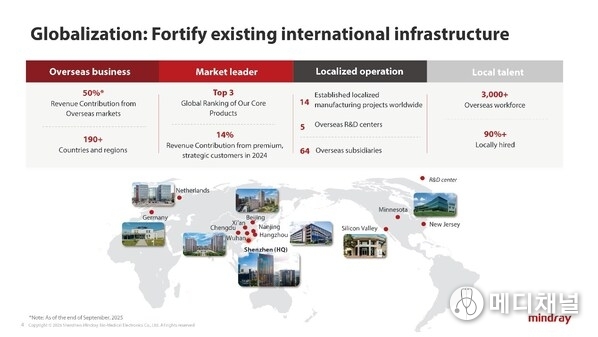
Beyond traditional sales and marketing localization, Mindray is committed to building local healthcare capacity, particularly in emerging markets. In the Middle East and Africa, for example, the company has established over 20 ultrasound training institutes, certifying thousands of local clinicians to deliver quality diagnostic services. By expanding local manufacturing, supply chain sourcing, and R&D operations, Mindray is positioning itself as a trusted strategic partner for healthcare stakeholders globally, rather than just a medical device supplier.
Recurring Business Expansion: Tapping High-Growth Segments with Technological Innovation
Recurring business, including IVD reagents, high-value consumables, IT solutions, and customer services, already contributed 40% of Mindray's total revenue in the first half of 2025. The company targets lifting this contribution to over 50%, leveraging significant growth potential in underpenetrated markets. In 2024, Mindray held less than 15% market share in China's addressable IVD market and around 4% globally, while its share in the global minimally invasive surgery (MIS) and minimally invasive intervention (MII) markets was only 0.8%.
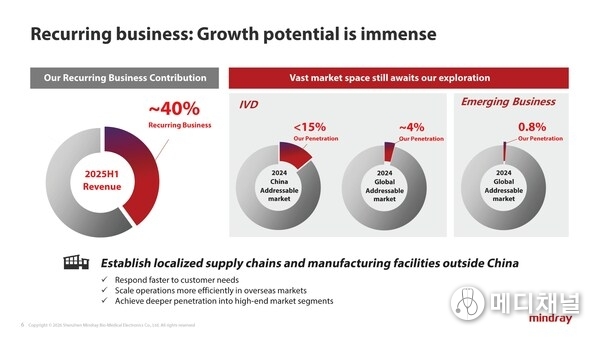
To accelerate growth, Mindray is establishing localized supply chains and manufacturing facilities for recurring business outside China, enabling faster response to customer needs and deeper penetration into high-end segments. The company's product roadmap includes expanding into a comprehensive "pan-interventional therapy" ecosystem covering percutaneous, transnatural orifice, and transrespiratory tract approaches, following its entry into cardiovascular intervention via the acquisition of APT Medical. In MIS, Mindray plans to extend beyond thoracic and general surgery to gynecology and urology, with a focus on developing specialized surgical robots.
Technological innovation is driving progress in recurring business lines. In IVD, Mindray's next-generation Estradiol detection reagent based on SEMS (Single Epitope Meta-Sandwich) technology offers exceptional drug interference resistance and nearly 100% linearity with mass spectrometry results, addressing critical unmet needs in breast cancer endocrine therapy. Its high-sensitivity cardiac troponin I assay reduces misdiagnosis risk by 50-fold, enhances anti-interference performance by 20-fold, and cuts patient observation time by 50%, with outcomes published in 16 top-tier medical papers. In MIS consumables, the intelligent stapler with Tissue Real-time Sense algorithm and ultrasonic scalpels featuring Smart Tissue Sensing and Enhanced Vessel Sealing technologies deliver precise, safe clinical outcomes.
Intelli-Digitalization: Breaking the Healthcare "Impossible Trinity" with Integrated Ecosystem
Mindray's Intelli-Digitalization pillar aims to build an integrated "Device + IT + AI" ecosystem, addressing the universal healthcare trilemma of balancing Quality, Access, and Cost—long considered an "Impossible Trinity." By automating mundane administrative tasks, the company's solutions free up healthcare staff to focus on direct patient care, restoring "time for healing."
The Intelli-Digital solution comprises five interconnected layers:
1. Foundational Layer: Industry-leading medical devices (patient monitors, ultrasound systems, anesthesia machines, etc.) generating high-quality clinical data.
2. Device Convergence Layer: Integration of traditionally isolated devices (e.g., combined intravenous-inhalation anesthesia, endoscope-ultrasound image fusion) to streamline workflows and reduce errors.
3. IT System Layer: Unified platforms including miCare (patient monitoring), miImaging (ultrasound), miInnolab (IVD), as well as CIS, LIS, and PACS, organizing fragmented data across devices.
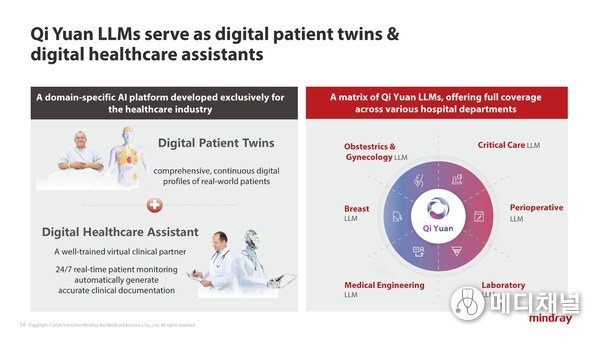
4. AI Layer: The Qi Yuan LLM family, launched in late 2024, now expanded from critical care to perioperative care, breast health, OBGYN, and laboratory settings. Deployed on-premises to protect patient privacy, Qi Yuan creates digital patient twins, enables 24/7 real-time monitoring, and automates clinical documentation, acting as a virtual clinical partner in high-stakes scenarios.
5. Future Development Layer: Ongoing innovations to be unveiled in coming phases.
Real-world case studies demonstrate the impact of these solutions:
- At Akershus University Hospital in Norway, miCare integrated with mWear wearable devices reduced ICU overcrowding, cut Rapid Response Team interventions by enabling early acute illness detection, and simplified data transmission to EMR systems—while extending monitoring to post-discharge patients at home.
- In Saudi Arabia, miImaging powers Seha Virtual Hospital (SVH), the world's largest online virtual hospital handling 400,000+ annual cases, enabling remote ultrasound consultations and bridging gaps between primary care clinics and specialist expertise.
- China's Jiangyou Regional Clinical Laboratory Center, using miInnolab, implemented a "2+6+X" model connecting 31 laboratories, achieving seamless data interoperability and unified diagnostic standards—recognized as a national model for regional healthcare collaboration.
- At Shanghai Renji Hospital's East Campus, Qi Yuan LLM reduced liver transplant surgery time by ~50% while enhancing safety and diagnostic efficiency, serving as a blueprint for expanding intelligent hospital models to 20 major overseas countries.
Vision: Better Healthcare for All Through Intelligent Innovation
Mindray's three core pillars are aligned with its mission to "Better healthcare for all." Globalization expands access to innovative solutions, recurring business ensures long-term profitability for sustained R&D, and Intelli-Digitalization addresses the industry's most pressing challenges. Looking ahead, the company plans to develop fully automated "lights-out factories" for laboratories and deploy intelligent anesthesia and ultrasound robots, further advancing embodied intelligence in healthcare.
"Our integrated ecosystem redefines the relationship between Device, IT, and AI—treating them as a seamless whole to turn data into actionable clinical insights," said May Li. "By breaking the 'Impossible Trinity,' we are making healthcare more precise, accessible, and efficient globally, solidifying our position as a leader in medical technology."
Mindray (300760.SZ) remains committed to driving healthcare innovation through its three strategic pillars, unlocking untapped potential in core and emerging business segments to deliver better care for patients worldwide.