
[ 메디채널 김갑성 기자 ] The two-evening programme on 27-28 January at The Ngee Ann Kongsi Auditorium at the SingHealth Duke-NUS campus convened clinicians, students, policymakers and partners to focus on the importance of outbreak preparedness and planetary health
SINGAPORE, Jan. 29, 2026 -- Singapore has hosted its first Global Health Film Festival, bringing together clinicians, students, policymakers and partners to examine some of the most pressing health challenges facing the region, from infectious disease preparedness to climate-related health risks.
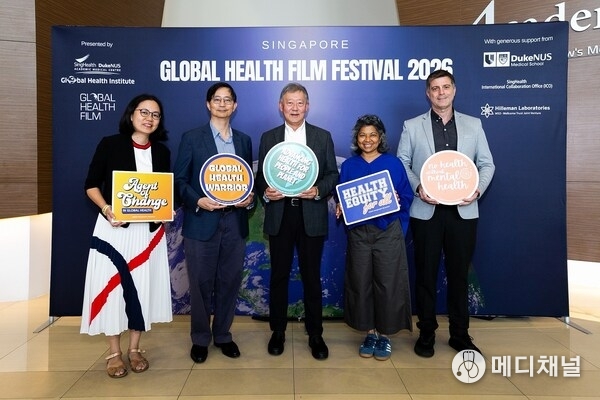
Organised by the SingHealth Duke‑NUS Global Health Institute (SDGHI), in collaboration with UK non‑profit Global Health Film, the festival was held on 27 and 28 January at the Ngee Ann Kongsi (NAK) Auditorium in the Singapore General Hospital campus. The two-night programme saw over 500 seatings, with many participants returning for both evenings.
The festival was opened by Professor Ng Wai Hoe, Group Chief Executive Officer, SingHealth, on Day One, and Professor Patrick Tan, Dean of Duke-NUS Medical School, on Day Two.
Through the lens of documentary storytelling, the Singapore Global Health Film Festival aimed to deepen understanding of global health challenges and foster dialogue across disciplines. Each evening featured a documentary screening, followed by a moderated panel discussion with clinicians, academics and the filmmaker, and concluded with networking sessions designed to encourage cross-sector collaboration.
Programme highlights
- Day One (27 January): Outbreak preparedness
The programme opened with Unseen Enemy, followed by a panel discussion on disease surveillance, health system resilience and community engagement. - Day Two (28 January): Planetary health
The second evening featured 2040, a documentary focused on climate and health, and a panel exploring adaptation, mitigation and health equity.
Why it matters
The festival comes at a time of heightened attention to global health in Asia, as countries apply lessons from recent pandemics while grappling with the growing health impacts of climate change. Building on an established international model previously held in Australia, the Netherlands, Tanzania, the United Kingdom and the United States, the Singapore edition marked the first time the Global Health Film Festival has been brought to Southeast Asia.
Professor Ng Wai Hoe, Group Chief Executive Officer of SingHealth, said, "Pandemics and climate change transcend geographical borders, and no country can address these issues in isolation. Our healthcare professionals have experienced, firsthand, how major health events such as disease outbreaks and pandemics impact every aspect of patient care and care delivery. SingHealth is proud to be part of this meaningful purpose in advancing global health as we foster conversations that bring together diverse perspectives with a shared purpose to benefit the patients and communities we serve."
Professor Patrick Tan, Dean of Duke-NUS, said the festival aligned closely with the School's educational mission. "Global health challenges rarely sit neatly within disciplines or borders. One of the roles Duke-NUS and our Global Health Institute play is helping to connect science, clinical insight and policy so that ideas can move into action. This festival brings together people who may not often share the same space, and it is in that exchange that meaningful solutions can begin. Our students also stand to gain immensely from engaging with real-world challenges through dialogue and reflection."
"Launching the country's first Global Health Film Festival underscores our commitment to shaping the agenda - turning insights into action and advancing policies that are impactful and implementable across Asia's diverse social, economic, and cultural contexts," said Professor London Lucien Ooi, Director of SDGHI.
The inaugural Singapore edition of the Global Health Film Festival was presented by SDGHI, a joint institute under the auspices of the SingHealth Duke-NUS Academic Medical Centre, and supported by the SingHealth International Collaboration Office, Duke-NUS Medical School and Hilleman Laboratories.
About the SingHealth Duke-NUS Global Health Institute
The SingHealth Duke-NUS Global Health Institute (SDGHI) is an enabling platform for global health activities across the SingHealth Duke-NUS Academic Medical Centre. Harnessing the strengths and expertise of SingHealth and Duke-NUS Medical School, the institute aims to address current and emerging health challenges across Asia and beyond. Working in collaboration with partners globally, we seek to tackle prevalent health challenges, strengthen health systems, and better insulate countries from pandemics and disease threats.
For more information, please visit https://www.duke-nus.edu.sg/sdghi
About SingHealth Duke-NUS Academic Medical Centre
The SingHealth Duke-NUS Academic Medical Centre (AMC) draws on the collective strengths of SingHealth and Duke-NUS Medical School to provide our patients and community with the best outcomes and experience.
By leveraging the synergies in clinical care, research and education created through our Academic Clinical Programmes, Disease Centres and Joint Institutes, the SingHealth Duke-NUS AMC fosters the exchange of scientific knowledge and clinical perspectives to accelerate innovation and new discoveries, advance the practice of medicine as well as nurture the next generation of healthcare professionals.
SingHealth delivers comprehensive, multi-disciplinary and integrated care across a network of acute hospitals, national specialty centres, polyclinics and community hospitals. Offering over 40 clinical specialties, SingHealth is Singapore's largest public healthcare cluster.
Duke-NUS, Singapore's flagship graduate-entry medical school, nurtures 'Clinician Plus' graduates to become leaders in the global healthcare and biomedical ecosystem, while scientists from its five Signature Research Programmes and 10 Centres transform medicine and improve lives in Asia and beyond.
For more information, please visit:
www.singhealthdukenus.com.sg
www.singhealth.com.sg
www.duke-nus.edu.sg